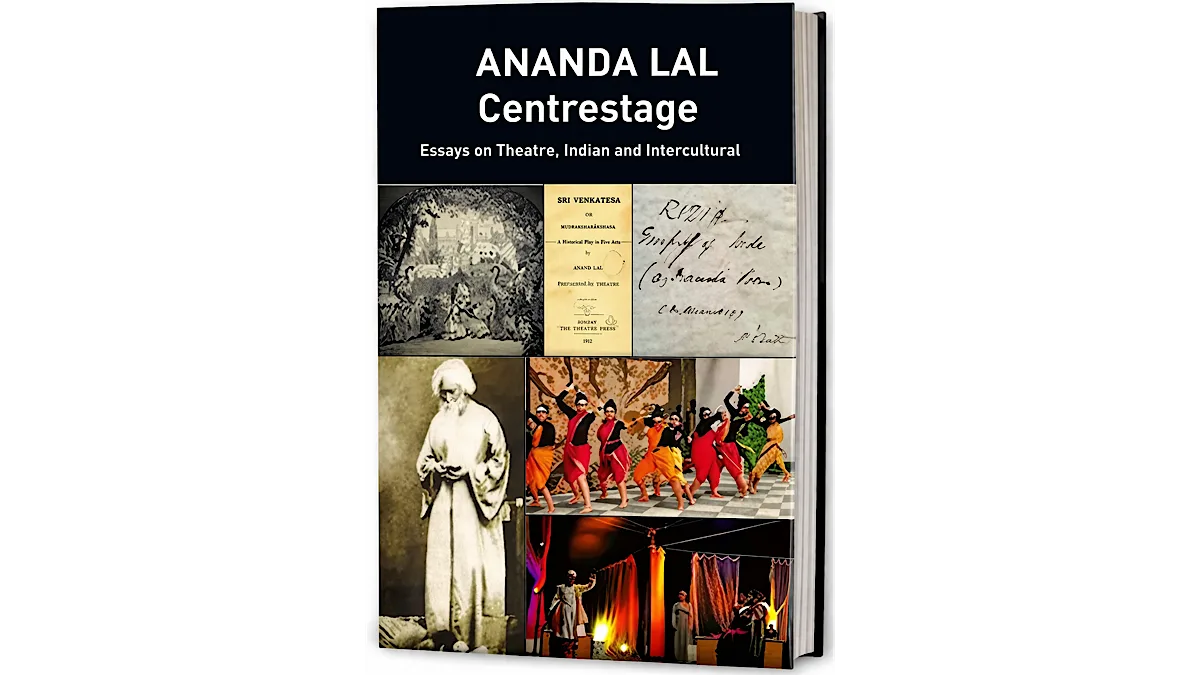
With over four decades of hands-on experience in the subject, Ananda Lal, professor, director and veteran drama critic, is amongst the most qualified to write an authoritative book on the topic of theatre. And he has done so. Though purportedly a collection of nine of his earlier essays,in essence Centrestage: Essays on Theatre, Indian and Intercultural, published by Seagull Books, is a reference book-like scholarly tome which provides readers with a comprehensive understanding of the theatre of the land, from its earliest history, right through its nuanced evolution to the current and contemporary trends which inform it.
The book begins by narrowing down the focus of Indian drama to look at it in the context of the English language. While a vast sea of literature does exist on the subjects of Indian drama and Indian writing in English which are by and far distinct in spite of the obvious overlaps, Lal introduces a new way of navigating it by combining the two. Delving into its virtually forgotten history (the writer laments the lack of proper documentation) he ferrets out three extant plays, tracing these back to the early nineteenth century.
Advertisement
Lal writes, “As a theatre director and theatre critic, I regard the three plays discussed here worthy of revival because of their content, so relevant to contemporary times. I can visualize them done either in academic antiquarian mode, replicating the social history of their context, or, more easily, edited and revised to suit current stage style and viewing expectations. That would be perhaps the most fitting tribute to these long-forgotten pioneers. The plays discussed are The Persecuted by Krishna Mohana Banerjea (1813-85); Rizia by Michael Madhusudan Dutt (1824-73) and Kaminee(1874), which though published anonymously at the time, Lal argues that there is a strong possibility of the writer being of Indian or at least Anglo-Indian origin.
In fact, Lal’s fascinatingdescription ofthe process by which he went about trying to trace the source of the play reveals the sheer depth of the research that went into the writing of these essays. Lal writes, “While stray, usually second-hand and inaccurate, citations of The Persecuted and Rizia crop up in literary histories and criticism, I have not seen any reference to Kaminee anywhere, other than a couple of bibliographical entries….According to the mandate of the Press and Registration of Books Act (1867), publishers had to deposit new books to the government (unstated: for the surveillance purposes after the First War of Indian Independence had caught the British off-guard). The invaluable register known as the Bengal Library Cataglogue proves us virtually infallible record of publications in all Indian language. Even though Kaminee does not reveal its writer’s name, the Catalogue lists him or her as G.Ritchie’ in the appropriate column.” What ensues isLal embarking on a detective-type hunt for this G.Ritchie, tracking the surname (it belonged to a famous family of that time), striking off the names of the possible contenders by a process of eliminationand eventually, if inconclusively (for the sake of accuracy) arguing that an Indian connection cannot be overruled.
Lal’s prose is often, though never overtly, laced with a doze of humor. Sample the first line of his Preface: “Theatre friends and well-wishers have often exhorted me to collect my writings in book form, so I should get it over with before it gets too late!”
Part 1 is full of other gems. The names of the chapters themselves are giveaways to the riveting content that follows. “A Brief Historiography of Modern Indian Theatre”; or “Political Perspectives: A Quartet from the 1970s”; or “Kolkata Theatre in the Twenty-First Century” or “ ‘The Play is the thing’: Theatre Education in Departments of Literature in India.”
The chapters, informative as they are, are studded with the author’s astute observations and comments. I found remarks like the following in the chapter, “Kolkata Theatre in the Twenty-First Century” spot-on:
“It has become a knee-jerk reaction among Bengalis, habitually bemoaning their lost glories, to write off contemporary Bengali theatre compared to past achievements in the art.” Other than reflecting wisdom and wit, it is another example of the understated humor that the writer’s prose is laced with.
One of the best aspects of Lal’s book, typical of the literary critic, drama or otherwise, is the delineation of the approach he takes. The reader is thereby clued in. For instance, we are aware of what to expect in the section on intercultural Indian drama. We know it startswith an introduction to its theory and practice, followed by a discussion of Peter Brook’s Mahabharata and includes an interview of him, a critique of the material on Indian theatre in international reference works, and an insider’s look at Tim Supple’s Midsummer Night’s Dream.
This chapter is particularly engaging. Lal writes, “Peter Brook’s birth centenary in 2025 and the rerelease of the film of his Mahabharata, now restored by his son Simon, makes my review and interview of him in 1989 – when he came to Calcutta on a promotional tour of India accompanying the release of the original five-hour-plus cut of the movie timely.”
Peter Brook: We said we would not decided in advance how long it should be. We realized that for the Western theatre it had to be very long, and nine hours is very long. We set out to make it the shortest form that would not betray it. Gradually, it came down to the division into three which came naturally, and the three became three normally long plays, three-hour plays, and then when we put the three together, it became three acts of a nine-hour play.
(THE REVIEWER IS EDITOR, FEATURES, THE STATESMAN)